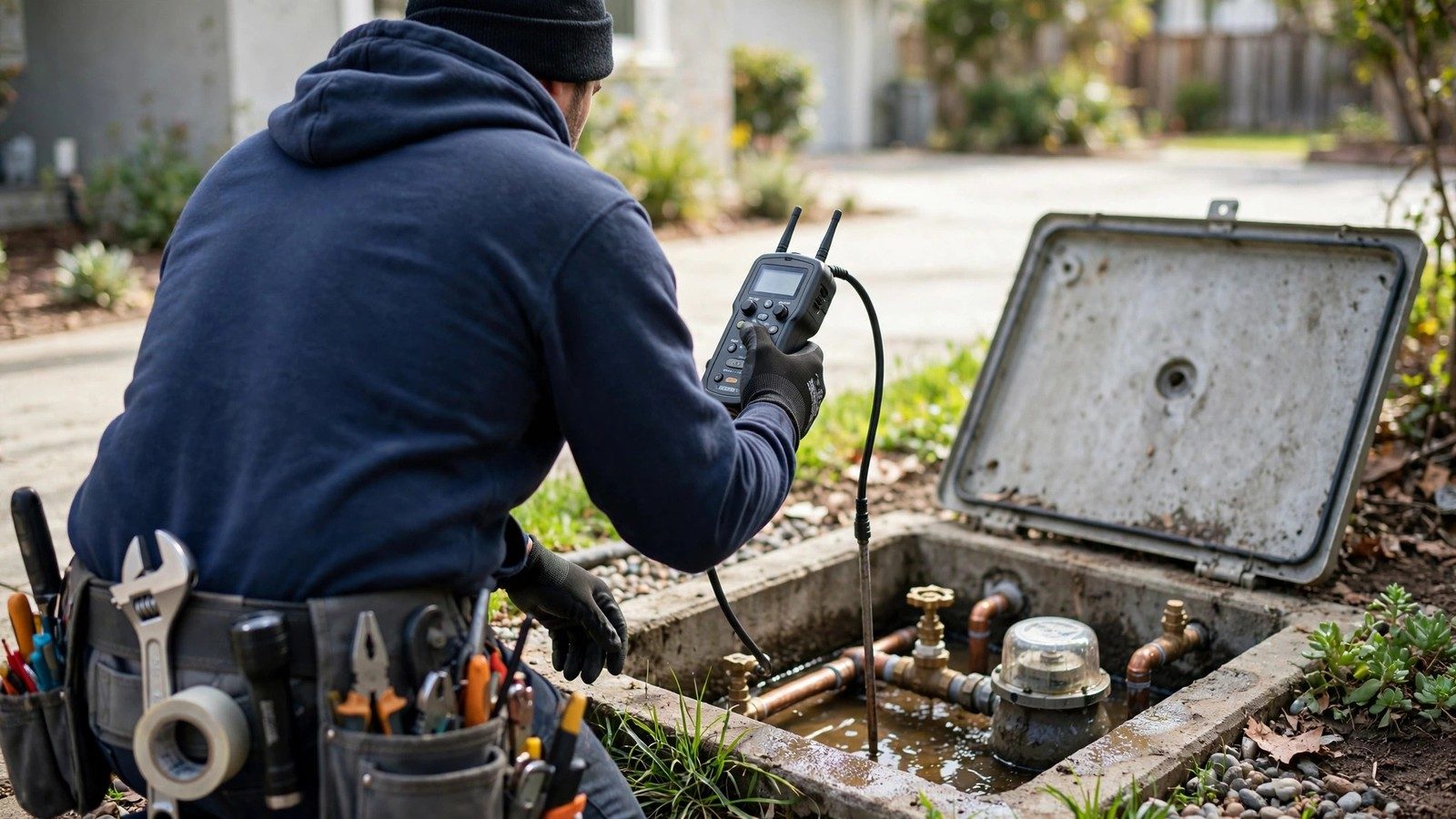
Finding a leak you can hear but not see
Most people calling about this don't say "leak detection," they say the meter is running with the water off, or they don't know where the water is coming from. Leak detection is the equipment and process that answers that question: acoustic listening devices, thermal imaging, and pressure testing that locate a leak behind a wall, under a slab, or underground without cutting into anything first.
Emergency leak detection: when it cannot wait
Water you can see is urgent, and so is water you cannot find. A wet ceiling, water seeping up through a floor, a meter that spins with every fixture off or a pool of water in the yard all justify a same-day call.
The longer a hidden leak runs, the more it costs in water, damage and repair. Our 24/7 line is open for exactly these calls, and we will locate the leak before anyone opens a wall or breaks concrete.
While our emergency plumber is on the way
A few quick checks help us narrow the search.
- • Turn off every fixture and appliance, then watch the water meter for movement.
- • Close the main shutoff if water is actively spreading, and see whether the meter stops.
- • Note where it is wet, warm or musty, and when you first noticed it.
- • Keep the latest water bill handy so we can compare usage.
The three places we check first
Under the slab
A warm spot on the floor or water pooling near the foundation often traces to a slab leak in the supply line running under the concrete.
Behind a wall
A ceiling or wall stain, especially near a bathroom, usually means a supply or drain line leak inside the wall cavity.
Between the meter and the house
A running meter with every fixture off often points to the underground line connecting the street meter to the home.
Pinpointing before any digging or demolition
The goal is a confirmed location before anything gets opened up. Acoustic equipment picks up the sound of water escaping under pressure, and thermal imaging can spot temperature differences from water moving through concrete or drywall. Once the leak is pinpointed within a small area, the repair itself, whether that's a slab leak, a wall repair, or a section of underground line, can be scoped and quoted accurately instead of guessed at.
A pressure test on the whole system, checking whether pressure holds steady with everything shut off, is often the first step, since a pressure drop confirms a leak exists somewhere in the closed system before any acoustic or thermal work narrows down exactly where. Ask your building department if a pressure test must follow a set method for your project. Florida plumbing rules are based on the International Plumbing Code (IPC).
What changes the cost
Want your real number? Call (561) 448-8545 and describe what you're seeing on the bill or the floor.
Matching the equipment to the likely location
| Suspected location | Equipment used |
|---|---|
| Under the slab | Acoustic listening plus thermal imaging |
| Behind a wall | Thermal imaging, sometimes moisture meters |
| Underground service line | Acoustic correlation and pressure testing |
Matching the right equipment to where the leak likely is keeps the inspection focused instead of running every test everywhere, which is part of what keeps the estimate accurate.
One check that helps narrow it down
- • Turn off every fixture in the house, then check if the water meter is still moving.
- • If it is, the leak is between the meter and your fixtures, not a fixture itself.
- • Note whether the sound, smell, or warm spot is closer to the street or the house.
Once the leak is found
If detection confirms a slab leak, repair options range from a spot repair to rerouting the line above the slab. If it's the main service line, repiping a section may be the more durable fix. Older homes in Deerfield Beach with original copper supply lines see this most often, and it's worth mentioning the home's approximate age and pipe material when you call, since it helps us bring the right equipment on the first visit instead of a second trip.
Meter still running with everything off
This is the single most common reason people call for leak detection. If the meter moves with every fixture and appliance off, water is escaping somewhere between the meter and the fixtures. The leak can be a running toilet, an irrigation line, the service line or a pipe under the slab.
We start by closing the house shutoff. If the meter stops, the leak is inside the house. If it keeps moving, the leak is on the line between the meter and the house, and we trace that line with electronic and acoustic equipment.
Leaks on the line between the meter and the house
The water service line runs underground from the meter to the house, so a leak there rarely shows itself. Clues include a soggy patch of lawn, a meter that runs with the house shut off, or noticeably lower pressure.
Who maintains which section can depend on where the meter sits, so ask the City of Boca Raton Utility Services Department at 561-338-7300 where the city line ends. We locate and repair the leak on your side.
Ceiling and wall leaks
A stain on a ceiling usually comes from a bathroom above, a supply line in the wall or an air handler drain. Water travels along framing before it shows, so the stain is often not directly under the leak.
We use moisture meters and thermal imaging to trace the source before any drywall is cut. That keeps the opening small and avoids repairing the wrong spot.
Irrigation, pool and yard leaks
An irrigation zone that runs weakly, a valve that never seems to close and a lawn that is wet when it has not rained all suggest a buried leak. The same clues apply to a pool or spa supply line and to a meter box that stays full of water.
We pressure-test the zone or line, listen for the leak and mark the spot so the repair is a small trench instead of a guess.
Common questions
Acoustic listening equipment and thermal imaging locate the leak's approximate position first, so any opening up that's needed is targeted rather than exploratory.
Yes. Slab and underground leaks often show up as a bill increase or a running meter well before any visible water appears.
Modern acoustic and thermal equipment typically narrows a leak's location to a small, specific area, which is what makes the repair itself faster and less invasive.
Yes. Turn off every fixture in the house and see if the water meter is still moving. If it is, the leak is somewhere between the meter and your fixtures, which helps narrow down what equipment we bring.
Already suspect a leak but not sure where? Call (561) 448-8545 and we'll talk through what you're seeing.
Ready to get this fixed? Call (561) 448-8545 and we'll get a technician on the way.
Finding leaks in very different buildings
A condo building near Mizner Park, a canal-front house in Golden Harbour, and a slab home in Boca Falls all leak in different ways. We adjust the method to the building and use acoustic and electronic tools to trace the source before any cutting. Near the beach, salt air also speeds corrosion on fittings behind walls.