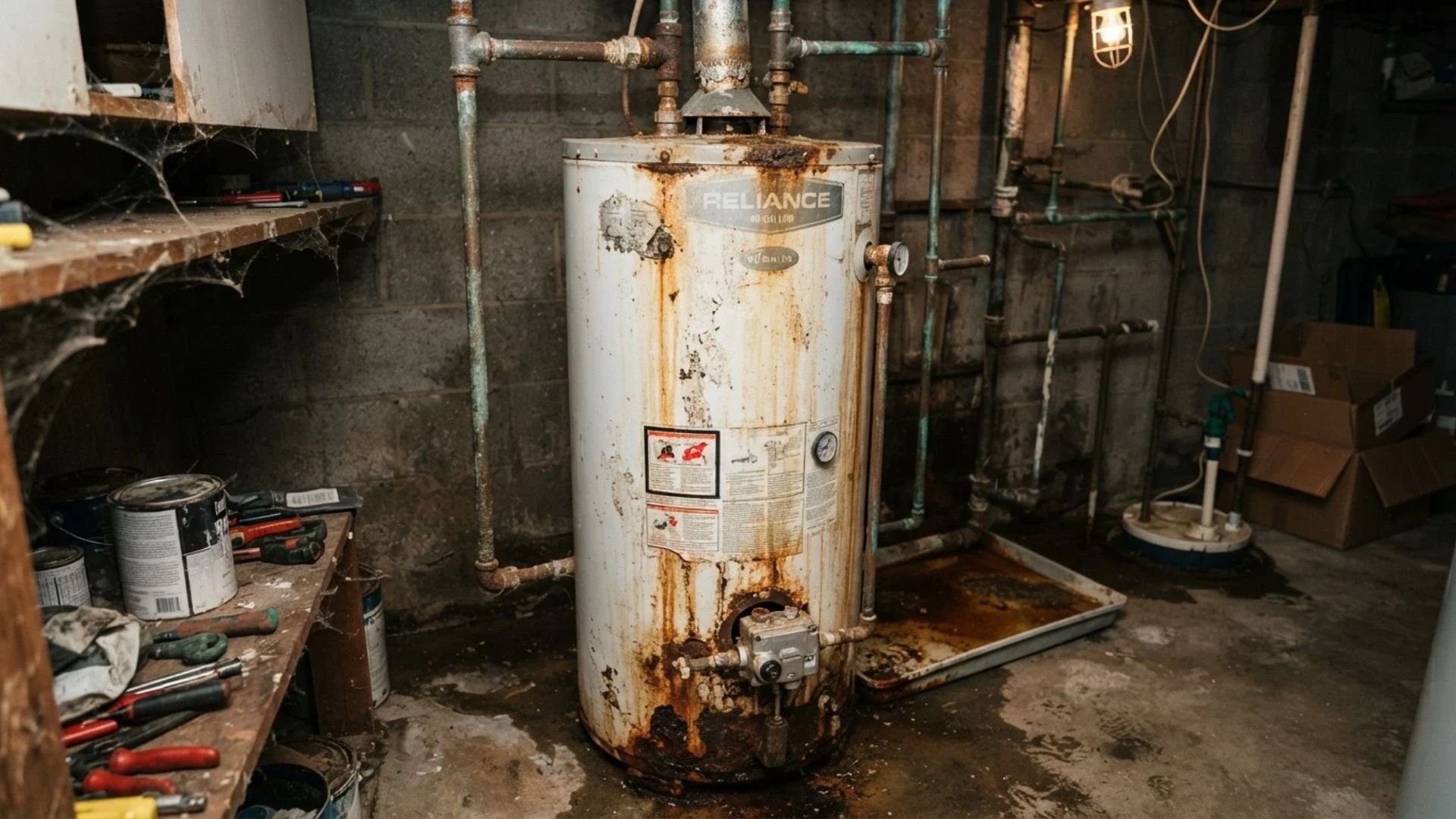
You've noticed a puddle forming under your water heater, right at the base of the tank near where it meets the garage floor or the edge of the slab. Before you panic or start looking up replacement costs, it's worth understanding what's actually happening, since the answer changes what you should do next.
Where the leak is actually coming from matters
Not every puddle under a water heater means the tank itself has failed. Water heaters have several components near the base and around the unit that can leak independently of the tank's structural integrity. That includes the drain valve at the bottom, the temperature and pressure relief valve's discharge pipe, and various fittings and connections where pipes join the unit.
Any of these can develop a leak while the tank body itself remains completely sound. Florida plumbing rules are based on the International Plumbing Code (IPC), so ask your building department what applies to a replacement.
The distinction matters because a valve or fitting leak is often a straightforward, relatively inexpensive repair, while a leak from the tank body itself, the actual steel shell holding the water, generally means the tank has corroded through and can't be repaired at all.
How to tell which one you're dealing with
- • Dry off the area completely, then watch closely to see exactly where new moisture appears first.
- • Check the drain valve at the bottom of the tank. A loose or worn valve is a common and repairable leak source.
- • Look at the discharge pipe from the temperature and pressure relief valve, usually on the side or top of the tank, running down toward the floor.
- • If water is coming from underneath the tank itself, with no clear connection to a specific valve or fitting, that points toward the tank body.
If you genuinely can't tell where it's coming from, that's a reasonable reason to call for a diagnosis rather than guessing, since correctly identifying the source is the difference between a same-visit repair and a full replacement conversation.
Why tank leaks aren't repairable
A water heater tank is a sealed steel vessel, typically lined with glass or another protective coating to slow corrosion. Once that lining breaks down in a spot, usually after years of use, the underlying steel is exposed to constant water contact and corrodes from the inside out.
By the time this shows up as a visible leak on the outside, the corrosion has already progressed to the point of actually breaching the tank wall, which means the surrounding metal is also weakened. There's no safe or lasting way to patch this from the outside. The tank needs to be replaced.
How old is too old?
Most tank water heaters have a working life of roughly 8-12 years, though this varies with water quality, usage patterns, and whether the tank has ever been flushed to remove sediment buildup. If your unit is within that range and you're seeing a leak from the tank body itself, replacement is almost certainly the right call rather than trying to find a workaround. If the unit is relatively new and leaking, especially in the first year or two, it's worth checking whether it's still under manufacturer warranty before assuming you're paying full price for a mistake that isn't really age-related.
You can usually find the manufacture date on a sticker on the unit itself, sometimes encoded in the serial number rather than printed plainly, which a technician can help decode if it's not obvious.
Sediment buildup: the quiet cause behind a lot of these leaks
Minerals in water settle out as it heats and cools inside the tank, and over years this sediment collects at the bottom. A thick layer of sediment does two things that make a leak more likely. It insulates the bottom of the tank from the heating element or burner, which is inefficient and can cause popping or rumbling sounds.
It also holds moisture against the tank floor in a way that accelerates corrosion at exactly the point where a tank most commonly fails. Flushing a tank annually to clear sediment is one of the few maintenance steps that genuinely extends a water heater's working life, though most homeowners never do it simply because nobody told them to.
What about the anode rod?
Most tank water heaters have a sacrificial anode rod inside, a piece of metal designed to corrode instead of the tank itself, protecting the tank's lining in the process. Once the anode rod is fully consumed, usually after several years depending on water chemistry, the tank itself starts corroding at an accelerated rate with nothing left to protect it. Replacing a spent anode rod before it's fully gone is a relatively inexpensive way to extend tank life, though by the time a tank is actually leaking, this maintenance window has already passed for that unit.
What to do right now if you're seeing this
Shut off the water supply to the unit and, if it's a gas unit, the gas supply as well, or switch off the breaker for an electric unit. This limits any further damage while you figure out next steps. If the leak is active and water is actively pooling rather than just a slow drip, treat it with some urgency, since a failing tank can sometimes fail more suddenly once the initial breach starts.
Repair or replace, either way we can help
If you're not sure which situation you're in, our water heater repair team can diagnose whether it's a repairable valve or fitting issue versus a tank that needs replacing. If it does turn out to be time for a new unit, water heater installation covers tank, tankless, and heat pump options sized to your household.
Either way, don't wait too long once you've spotted a leak. A repairable issue left alone can sometimes worsen into a bigger problem, and a failing tank rarely gets better on its own.
Condo owners: whose water heater is it?
In a condominium, ownership of the heater and its supply lines is set by your declaration. Florida Statute 718.113(1) makes the association responsible for maintaining the common elements, except limited common elements the declaration assigns to the unit owner. Read the declaration or ask your management office before you authorize a replacement.
While you wait, shut off the cold supply to the heater and keep the area dry. A heater leaking onto a floor shared with a neighbor below is an emergency worth a phone call to management right away.
Our crews also serve Highland Beach and Deerfield Beach, so help is close when you need it.
One local question
Check your declaration. Florida Statute 718.113(1) makes the association responsible for maintaining the common elements, except limited common elements assigned to the unit owner, so who owns the heater depends on how your declaration is written. Shut off the cold supply and call your management office, then call us at (561) 448-8545.